Seismic design
How RetainX Calculates Seismic Earth Pressure: The Mononobe-Okabe Method
When a retaining wall sits in a seismic zone, typical soil forces are not the only items to account for. Ground shaking adds a dynamic component to the soil pressure behind the wall on top of the static active pressure that’s always there. Getting this right matters for three checks RetainX runs: sliding, overturning, and bearing. Get the seismic increment wrong, and either the wall is under-designed for a real earthquake, or it’s needlessly over-built because static and seismic loads were double-counted.
This article walks through the Mononobe-Okabe (M-O) method RetainX uses to compute that seismic increment, and how it’s kept separate from the static load rather than blended into a single number.
The Mononobe-Okabe equation
M-O extends Coulomb’s active earth pressure theory to include horizontal seismic inertia. The seismic active pressure coefficient is:
\[ K_{AE} = \frac{\cos^2(\phi - \psi - \beta)}{\cos\psi \, \cos^2\beta \, \cos(\delta+\beta+\psi)\left[1 + \sqrt{\dfrac{\sin(\phi+\delta)\,\sin(\phi-\psi-i)}{\cos(\delta+\beta+\psi)\,\cos(i-\beta)}}\right]^2} \]
Where:
- \(\phi\) — soil internal friction angle
- \(\delta\) — wall/soil interface friction angle
- \(i\) — backfill slope angle
- \(\beta\) — wall batter from vertical (RetainX always assumes a vertical wall, so \(\beta = 0\))
- \(\psi\) — the seismic inertia angle, \(\psi = \arctan(k_h)\), where \(k_h\) is the horizontal seismic coefficient
Everything here except \(\psi\) is already part of a wall’s static design including friction angle, wall friction, and backfill slope (batter is not accounted for). The seismic case only adds one new input, the horizontal seismic coefficient, and folds it in through \(\psi\).
The total seismic active thrust is then:
\[ P_{AE} = \frac{1}{2}\,\gamma_{soil}\,H^2\,(1-k_v)\,K_{AE} \]
RetainX assumes the vertical seismic coefficient \(k_v = 0\) by default — consistent with Caltrans’ own guidance (Memo to Designers 5-5) that vertical and horizontal accelerations aren’t assumed to act simultaneously.
Splitting static from seismic: ΔPAE
\(P_{AE}\) above is the total active thrust — it include both the seismic AND static lateral forces. To know how much of the demand on the wall is genuinely new because of the earthquake, RetainX subtracts the static active force:
\[ \Delta P_{AE} = \max\Big(0,\; P_{AE}\cos\delta - P_{static}\Big) \]
This isn’t an arbitrary implementation choice — it’s standard practice, documented in two sources:
- Caltrans Memo to Designers 5-5 (2014), p.7: “the total soil thrust, PAE, is separated into two components, the static active soil pressure in a triangular shape and the dynamic soil pressure in a rectangular shape.”
- FHWA-HRT-05-067, §2.4.2.3(a), Figure 2-14: shows the same decomposition, and specifies where each component acts — the static component at 0.33H from the base, the dynamic increment at 0.6H.
The figure below redraws that decomposition for RetainX’s own wall geometry:
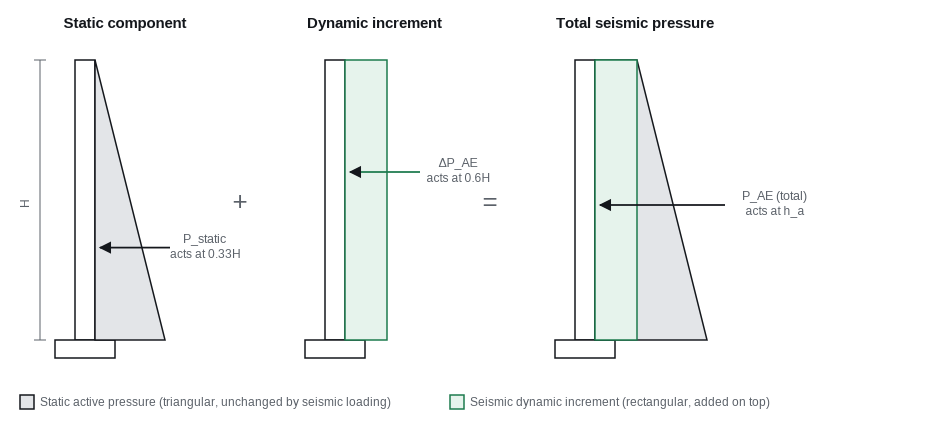
Figure 1 — the static component (grey) acts at 0.33H from the base; the dynamic increment (green) acts higher, at 0.6H (or other heht; together they sum to the total seismic pressure distribution. Adapted from FHWA-HRT-05-067, Figure 2-14.
RetainX mirrors the 0.6H detail directly: its default seismic moment-arm height is 0.6H, matching the FHWA figure, and that value is locked in whenever the seismic coefficient is calculated directly from \(k_h\) rather than entered manually from a project-specific report.
The zero floor. \(\Delta P_{AE}\) can, in principle, come out negative — if the static active force already exceeds the total M-O thrust for a given input combination. RetainX floors it at zero, as shown in the equation above, so seismic loading is never allowed to reduce the design demand below the static case. Worth being precise here: neither Caltrans nor FHWA states this floor explicitly in the documents above — it’s sound engineering judgment layered on top of the documented decomposition, not an independently cited rule.
Wiring it into the wall’s total load
Once \(\Delta P_{AE}\) is known, it’s added on top of the static forces (soil, water, surcharge — never subtracted) to get the seismic design case:
\[ P_{h,\,seismic} = P_{soil} + P_{water} + P_{surcharge} + \Delta P_{AE} \]
And for the overturning check, the moment contribution uses that same 0.6H arm:
\[ M_{o,\,seismic} = \sum \big(P_i \cdot a_i\big) + \Delta P_{AE} \cdot (0.6H) \]
This total feeds the sliding, overturning, and bearing factors of safety used specifically for the seismic case which are checked against IBC 2018’s reduced thresholds of 1.1, rather than the higher thresholds used for the static/typical case.
The manual “geotech report” path
RetainX also lets an engineer substitute a project-specific seismic force value taken from an independent geotechnical report, bypassing the Mononobe-Okabe calculation entirely for projects where a site-specific seismic analysis has already been performed. That substituted value is floored at zero the same way as the calculated one, for the same reason a sign error in a manually entered value can’t silently produce a seismic case that looks safer than the static one.
One limit worth flagging
The M-O closed-form solution has a validity requirement: \(\phi > i + \psi\) (the friction angle must exceed the sum of the backfill slope and the seismic inertia angle). Violate it — a very steep backfill combined with a high seismic coefficient — and the square-root term above goes undefined. RetainX checks for this condition directly and raises a warning to the user rather than silently returning a nonsensical result.