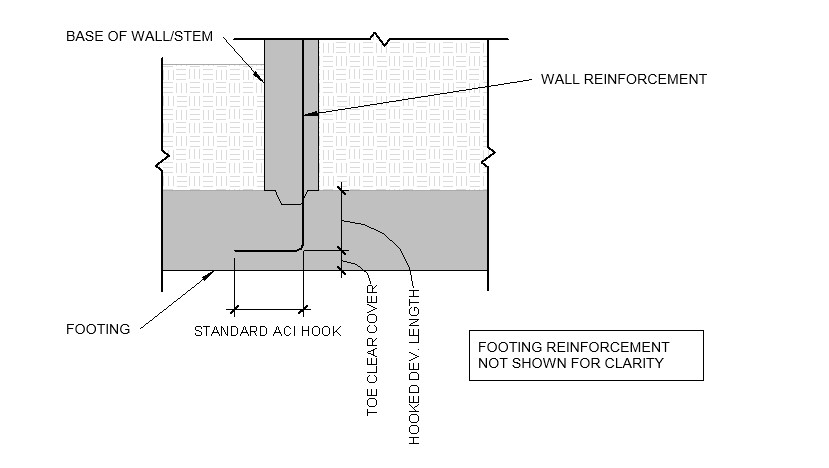
Reinforcement detailing
How RetainX Checks Hooked-Bar Development Length in Footings
A cantilever wall's stem reinforcement has to anchor into the footing with enough embedment to develop its full yield strength - otherwise the bar could pull out of the concrete before it ever reaches the stress it was designed for. In a thin footing, there often isn't enough straight vertical depth to do that. The usual fix is a standard hook: bend the end of the bar 90° or 180°, which lets it develop the same strength in a shorter overall length than a straight bar would need. RetainX checks whether that hooked length still fits inside the footing, and flags the design when it doesn't.
This article walks through the ACI 318 provision behind that check, what changed when ACI rewrote it for the 2019 edition, and the assumptions RetainX makes where the code leaves room for engineering judgment.
The ACI 318-14 formula
Under ACI 318-14 §25.4.3.1(a), the development length of a hooked bar in tension is:
\[ \ell_{dh} = \frac{f_y\,\psi_e\,\psi_c\,\psi_r}{50\,\lambda\,\sqrt{f'_c}}\,d_b \]
Where:
- \(f_y\) — bar yield strength (psi)
- \(f'_c\) — concrete compressive strength (psi)
- \(d_b\) — hooked bar diameter (in.)
- \(\psi_e\) — epoxy-coating factor: 1.2 if coated, 1.0 if uncoated
- \(\psi_c\) — cover factor: 0.7 for adequate side cover (≥2.5 in. for No. 11 bars and smaller), 1.0 otherwise
- \(\psi_r\) — confining-reinforcement factor: 0.8 if the hook is tied per §25.4.3.2, 1.0 otherwise
- \(\lambda\) — lightweight-concrete factor: 0.75 for lightweight, 1.0 for normalweight
RetainX runs this check with \(\psi_e = 1.0\) (uncoated), \(\psi_r = 1.0\) (no credit taken for tying the hook), and \(\lambda = 1.0\) (normalweight) — all standard, conservative defaults. The one factor worth calling out is \(\psi_c = 0.7\): RetainX assumes the favorable side-cover case rather than checking it, since the app doesn't collect side cover as a separate input. On a typical wall footing this assumption holds, but it's worth knowing it's an assumption and not a verified condition.
What changed in ACI 318-19
ACI rewrote this provision for the 2019 edition, based on newer hooked-bar research (Sperry et al. 2017–2018). The commentary is explicit about why: testing found that concrete breakout, not pullout, was the predominant failure mode for hooked bars — and that closely-spaced hooks fail at a lower load per bar than widely-spaced ones, because each hook's breakout cone overlaps its neighbors' and the effective breakout surface shrinks. The 318-14 formula above had no way to account for that.
The 318-19 formula (§25.4.3.1a) is:
\[ \ell_{dh} = \frac{f_y\,\psi_e\,\psi_r\,\psi_o\,\psi_c}{55\,\lambda\,\sqrt{f'_c}}\,d_b^{1.5} \]
Three things are different, not just the coefficient:
- \(d_b\) is now raised to the 1.5 power instead of 1 — development length no longer scales linearly with bar diameter.
- A new location factor \(\psi_o\) was added: 1.0 if the hook terminates inside a column core with ≥2.5 in. side cover (or ≥6\(d_b\) side cover generally), 1.25 otherwise.
- \(\psi_r\) now penalizes rather than merely declines to reward. Where 318-14's \(\psi_r\) ranged from 0.8 (favorable) to a neutral 1.0 (default), 318-19's \(\psi_r\) is 1.0 for widely-spaced or adequately confined hooks (spacing ≥6\(d_b\), or confining steel ≥0.4 times the hooked-bar area) and 1.6 for everything else — a 60% increase in required length for closely-spaced, unconfined hooks. That's the breakout-failure finding showing up directly in the numbers.
\(\psi_c\) also changed from a step function to a continuous one:
\[ \psi_c = \begin{cases} \dfrac{f'_c}{15{,}000}+0.6, & f'_c < 6000\text{ psi} \\[4pt] 1.0, & f'_c \ge 6000\text{ psi}\end{cases} \]
Put together, for a typical stem bar these changes push required development length up, often substantially — ACI's own commentary notes lengths computed under 318-19 can run as much as 50% longer than the pre-2019 code required for the same bar.
How RetainX applies it
The check itself is simple once \(\ell_{dh}\) is known: add the clear cover to the bottom reinforcement, and compare against the footing thickness.
\[ \ell_{dh} + c_c \le t_f \]
If that inequality fails, RetainX raises “Footing Not Deep Enough For Hooked Bar Development.”
Under 318-19, RetainX doesn't collect tie spacing or side cover as separate inputs, so there's no way to justify the favorable 1.0 value for \(\psi_r\) or \(\psi_o\). Rather than assume the favorable case the way the 318-14 path does for \(\psi_c\), RetainX takes the conservative route here: \(\psi_r = 1.6\) and \(\psi_o = 1.25\), the "Other" case for both. That's a deliberate asymmetry between how the two editions are handled — the 318-19 check will flag thinner footings than a user who could justify the favorable factors with as-built tie spacing and cover might strictly need, but it won't silently under-report a real breakout risk.
One limit worth flagging
ACI 318 actually defines \(\ell_{dh}\) as the greater of three values — the formula above, plus two absolute minimums: \(8d_b\) and 6 in. (150 mm). RetainX's check only evaluates the formula; it doesn't separately enforce those two floors. For the bar sizes and concrete strengths typical of a cantilever wall stem, the formula value governs and the floors are academic — but on a very small bar in high-strength concrete, it's possible for a floor to control instead. Worth knowing the check doesn't chase that edge case yet.
Sources
- ACI CODE-318-14: Building Code Requirements for Structural Concrete and Commentary, §25.4.3.1–25.4.3.2, Table 25.4.3.2
- ACI CODE-318-19: Building Code Requirements for Structural Concrete and Commentary, §25.4.3.1–25.4.3.2, Table 25.4.3.2, and Commentary R25.4.3.1 (Sperry et al. 2017a, 2017b, 2018; Ajaam et al. 2018)